

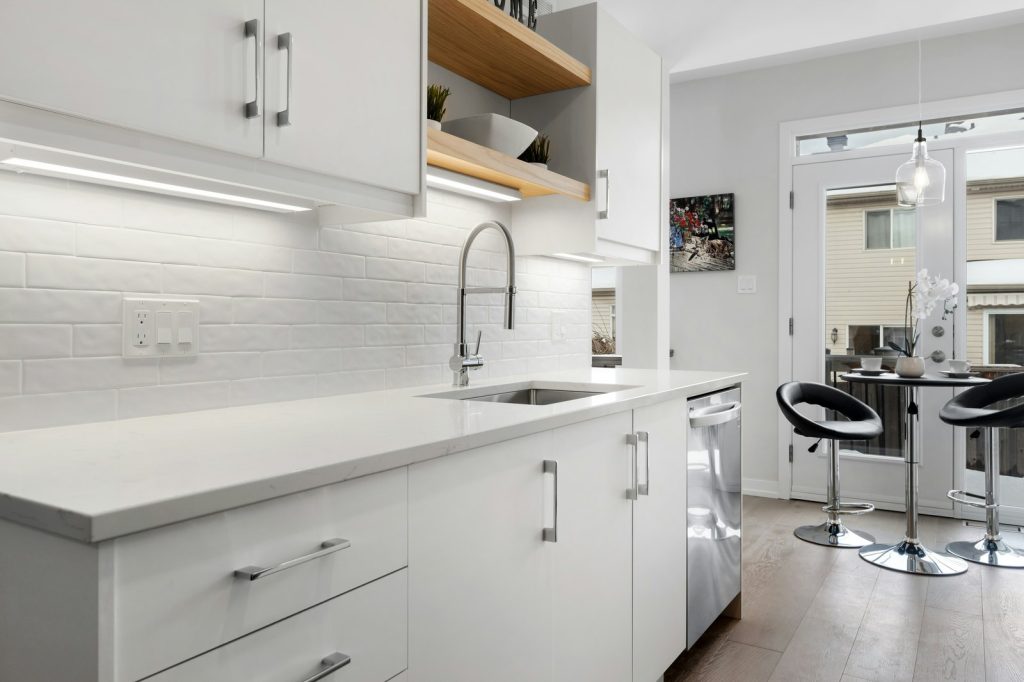
Under-cabinet lighting is one of the best-value upgrades a kitchen can get. It puts light exactly where you chop and read recipes, kills the shadow your own body casts onto the counter, and makes the whole room look finished. The cost is not really about the lights themselves, which are cheap. It splits on one decision that changes the whole job: plug-in or hardwired.
The fork that sets the price: plug-in or hardwired
Plug-in under-cabinet lighting is the cheap, simple route. You stick LED strips under the cabinets and run them to a nearby outlet through a small adapter, and you can do it yourself in an afternoon. The trade-off is a visible cord and plug, and the lights switch at the strip or a little inline switch rather than on the wall.
Hardwired lighting is the clean version. The power comes straight from a circuit, hidden inside the wall and cabinets, with no cord showing and a proper wall switch or dimmer running the lot. It looks built-in because it is, but it needs an electrician to bring the supply, fit the driver and add the switch, so it costs more. That single choice, hidden-and-switched versus quick-and-plugged-in, is the biggest lever on the price.
LED, and which style
Whatever you choose, the light itself should be LED. Older strip and halogen fittings run hot, which is the last thing you want a few inches under a cabinet and over food, and they burn out far sooner. LED runs cool, sips power and lasts for years. Within LED there are three common styles: continuous strip or tape for an even wash of light along the whole counter, puck lights for pools of light in spots, and rigid bars for bright, uniform coverage. Strip is the usual choice for a working kitchen counter; pucks suit accent spots like a glass display cabinet.

How much cabinetry you are lighting
After the plug-in-or-hardwired call, the next driver is length. The more linear feet of cabinet you want lit, the more strip or the more fixtures you need, and the longer the install takes. A short single run over one counter is a small job; wrapping light around an L-shaped kitchen with an island is a bigger one. It is worth deciding up front which runs you actually use, rather than lighting every inch for the sake of it.
The hidden part of a hardwired job
With a hardwired install, most of the cost is the part you never see. Low-voltage LED needs a driver, a small transformer that steps the house voltage down to what the strips run on, tucked out of sight. The power has to be tapped from a circuit, usually the kitchen lighting, and a switch or LED-compatible dimmer added on the wall. And as with any Jamaican job, getting that supply through solid block or concrete means surface conduit or chasing into the wall and making good. None of it is dramatic, but it is the difference between a tidy built-in result and a cord hanging down to a plug.
Do it at reno time
The single biggest saving is timing. If you are building or redoing the kitchen, run the under-cabinet wiring while the walls are open and the cabinets are going in, and the hidden, hardwired result costs a fraction of what it does to retrofit later. Threading concealed wiring into a finished concrete kitchen after the fact is the expensive version, which is exactly why plug-in strips exist as the pragmatic retrofit. Plan it with the cabinets, the way we approach the whole room in wiring a kitchen.
Who should do it, and how we quote
Plug-in LED strips near an existing outlet are a fair homeowner job. A hardwired install, with its driver, tapped circuit and wall switch, is electrician work, and if it involves a new circuit it should pass a Government Electrical Inspectorate inspection. The honest way to price it is to see the kitchen, measure the runs you want lit, and check where the power will come from. We handle it as part of lighting installation. You can read how the strips themselves work under LED strip light.
Related reading
- Wiring a kitchen: circuits, outlets and safety for planning kitchen lighting and circuits together.
- What does it cost to install security lighting in Jamaica? for how lighting jobs are priced more broadly.
- What does it cost to install a ceiling fan in Jamaica? for another fixture job where access drives the price.
- Lighting installation for fitting under-cabinet and kitchen lighting to standard.
What is the biggest factor in under-cabinet lighting cost?
Whether it is plug-in or hardwired. Plug-in LED strips run to a nearby outlet and are cheap and DIY-friendly, but show a cord and switch at the strip. Hardwired lighting hides the power in the wall and cabinets with a proper wall switch, but needs an electrician to bring the supply, fit a driver and add the switch, so it costs more.
Should under-cabinet lighting be LED?
Yes. Older strip and halogen fittings run hot, which you do not want inches under a cabinet over food, and they burn out sooner. LED runs cool, uses little power and lasts for years. Within LED, continuous strip suits an even wash along a working counter, while puck lights suit accent spots like a display cabinet.
Does the size of the kitchen change the cost?
Yes. After the plug-in-or-hardwired decision, length is the main driver. The more linear feet of cabinet you light, the more strip or fixtures you need and the longer the install takes. A single run over one counter is small; wrapping light around an L-shaped kitchen with an island is a bigger job.
What makes a hardwired install cost more?
The hidden parts. Low-voltage LED needs a driver, a small transformer stepping the house voltage down, tucked out of sight. The power must be tapped from a circuit and a wall switch or dimmer added, and in a block or concrete home that supply runs in surface conduit or is chased in and made good. That concealed work is most of the cost.
Is it cheaper to install under-cabinet lighting during a renovation?
Much cheaper. Running the wiring while the walls are open and the cabinets are going in gives the hidden, hardwired result for a fraction of the retrofit cost. Threading concealed wiring into a finished concrete kitchen afterward is the expensive version, which is why plug-in strips exist as the practical retrofit option.
Can I install under-cabinet lighting myself?
Plug-in LED strips near an existing outlet are a fair homeowner job. A hardwired install, with its driver, tapped circuit and wall switch, is electrician work, and if it adds a new circuit it should pass a Government Electrical Inspectorate inspection. If you want the clean, switched, cord-free look, that is the professional route.
The next step
Under-cabinet lighting is a small upgrade that changes how a kitchen works, and the cost comes down to plug-in versus hardwired and how much counter you want lit. Get a free quote or message us, tell us your kitchen and the look you want, and we will talk you through both routes and price the one you choose.