

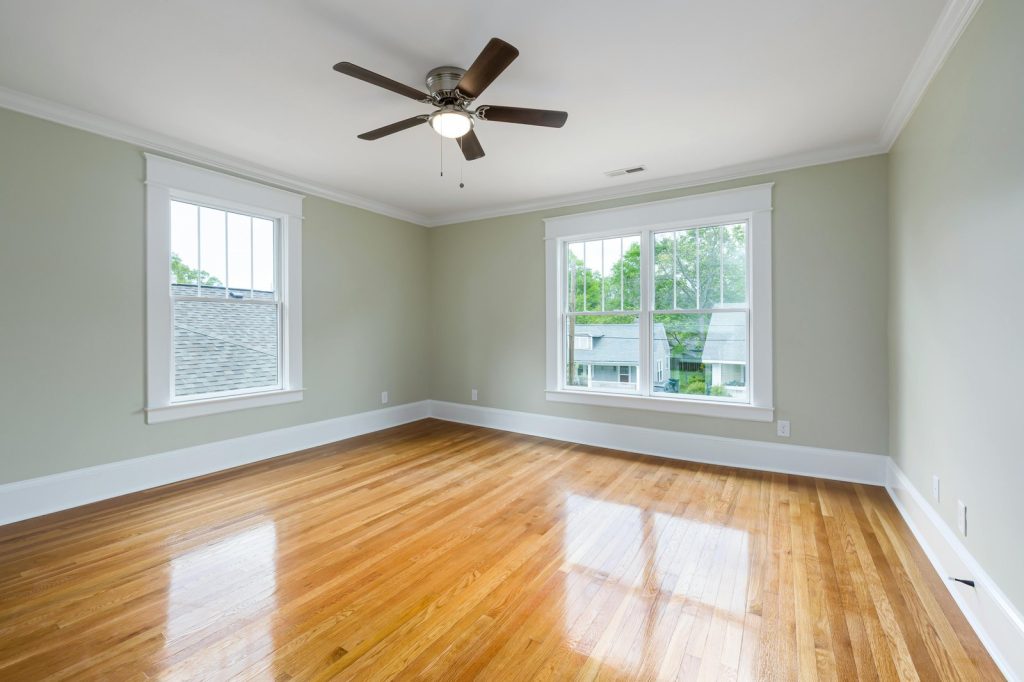
Ask what a ceiling fan costs to install and the honest answer is that it depends, because the fan on the box is the easy part. What actually moves the price is the ceiling above it: whether there is already a fan point there, what that point is made of, and how high it sits. We would rather explain what drives the number than quote you a figure that turns out wrong once we see the room.
The thing that decides most of the cost
The biggest factor by far is whether you are replacing an existing fan or putting one where none has been before. If there is already a fan or light there, with a switch and a box in place, swapping in a new fan is a quick, straightforward job. If you want a fan in a fresh spot with no wiring, the work is a small project: running cable to the location, adding a wall switch, and cutting in a box. Same fan, very different jobs, and that is why a quote always starts with going to look.
The box has to be built for a fan
A ceiling fan cannot simply hang off an ordinary light box. A fan spins and rocks slightly, and over time that movement will work a standard box loose, which is how you end up with a fan that wobbles, drops or pulls out of the ceiling. A fan needs a fan-rated box, braced to the structure to carry the weight and the motion. If the spot you want only has a light box, part of the job, and part of the cost, is fitting the right support. This is not a corner to cut, because the failure mode is a heavy fan coming down.
The Jamaican factor: concrete ceilings
Here is what makes a Jamaican fan install different from the figures you find online. A lot of those assume a timber-joist ceiling with an attic above, where an electrician can reach in, fix a brace and pull cable easily. Many Jamaican homes have a concrete slab ceiling instead, with no attic and nowhere to hide a cable. Mounting a fan there means anchoring into the concrete and, where there is no existing point, running the supply in surface conduit or chasing it in. It is perfectly doable, and we do it often, but it is more work than the timber-ceiling assumption, so it costs more. If there is already a fan point in that slab, you are back to the easy end of the scale.
What else moves the number
A few other things add to it. A high or vaulted ceiling needs an extension downrod and safe access to reach, which takes longer. Adding a wall switch, or a speed control or remote where there was none, is extra. And the fan itself is yours to buy, separate from the install, so the model you choose sits on top of the labour. The matching wiring detail, the circuit and switch a fan should be on, is covered in what size wire and breaker does a ceiling fan need? You can read how the fans themselves are built under ceiling fan.
Who should do it
Swapping a fan on an existing, properly braced point is at the simpler end, but anything involving a new location, a concrete ceiling, new wiring or a fan-rated box belongs with an electrician, both for the wiring and because a fan is a heavy thing spinning over your head. A fan mounted on the wrong box is a genuine hazard. We handle fan installs as part of lighting installation, and the first step is always a look at the ceiling so the quote is real.
Related reading
- What size wire and breaker does a ceiling fan need? for the circuit and switch behind the fan.
- What does it cost to rewire a house in Jamaica? for how local cost factors work on a bigger job.
- What to expect on an electrical site assessment for how we work out a real quote.
- Lighting installation for fitting fans and fixtures to standard.
What is the biggest factor in ceiling fan installation cost?
Whether there is already a fan point where you want one. Replacing an existing fan or light, with a switch and box already there, is quick and inexpensive. Putting a fan in a fresh location with no wiring is a small project: running cable, adding a switch and cutting in a box. The same fan can cost very differently depending on this.
Why does a ceiling fan need a special box?
Because a fan spins and rocks slightly, and that movement will work an ordinary light box loose over time, which is how fans wobble, drop or pull out of the ceiling. A fan needs a fan-rated box braced to the structure to carry both the weight and the motion. If only a light box is present, fitting proper support is part of the job and the cost.
Does a concrete ceiling cost more for a fan?
Often, yes. Many online figures assume a timber ceiling with an attic, where cable and bracing are easy to reach. A concrete slab ceiling, common in Jamaica, has no attic, so mounting means anchoring into the concrete and running any new supply in surface conduit or chasing it in. That is more work than the timber assumption. An existing fan point in the slab brings it back down.
Does a high ceiling change the price?
Yes. A high or vaulted ceiling needs an extension downrod to hang the fan at the right height and safe access equipment to reach it, both of which add time. Angled or beamed ceilings can need special mounts too. It is still routine work, just more involved than a standard-height ceiling.
Is the fan included in the installation cost?
No. The fan itself is something you buy separately, and the model you choose sits on top of the installation labour. A simple fan and a large designer one install similarly but cost very differently to buy, so the price of the unit is your choice and separate from the wiring work.
Can I install a ceiling fan myself?
Swapping a fan on an existing, properly braced point is at the simpler end, but a new location, a concrete ceiling, new wiring or fitting a fan-rated box is electrician work. A fan is a heavy object spinning above your head, and one mounted on the wrong box is a real hazard, so the support and any wiring should be done properly.
The next step
The only honest way to price a ceiling fan is to look at the ceiling, see whether there is already a point, and check what it is made of. Get a free quote or message us, tell us where you want the fan and what your ceiling is, and we will give you a real number rather than a guess.