

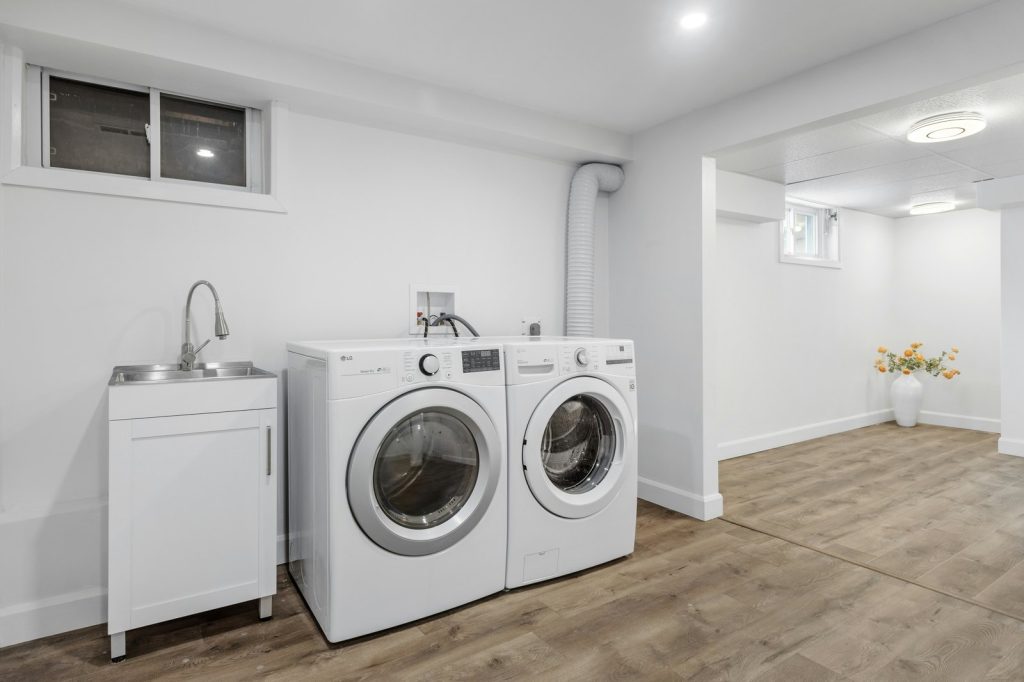
Of all the big appliances, an electric clothes dryer is one of the easiest to size, because almost all of them want the same circuit. Here is the standard answer, plus the one piece of confusion that catches people swapping out an old dryer, and the exception that changes everything if yours runs on gas.
The standard electric dryer circuit
An electric dryer runs on 240 volts, because it has to power a heating element as well as the drum motor. The near-universal setup is a 30-amp double-pole breaker on 10-gauge copper wire, run as a four-wire circuit, ending at a NEMA 14-30 outlet that the dryer plugs into.
That is it for the vast majority of household electric dryers. Unlike a range or an air conditioner, there is little variation to worry about; 30 amps and 10-gauge copper is the answer almost every time. Still worth a glance at the dryer’s own label, but you will rarely be surprised.
One thing not to do: never put thinner wire on that 30-amp breaker. A 30-amp breaker will happily let 30 amps flow, and 12-gauge wire cannot carry that safely. It will overheat and can start a fire long before the breaker trips. Ten-gauge copper is the minimum, not a suggestion.
Three-prong versus four-prong
This is where people get stuck, almost always when a new dryer will not plug into the old wall outlet.
Older homes often have a three-prong dryer outlet, the NEMA 10-30, which was the standard before the code changed in the 1990s. It carried two hots and a combined neutral-and-ground on a single pin. The problem is exactly that combination: sharing neutral and ground creates a shock risk. Modern dryers use a four-prong plug on the NEMA 14-30 outlet, which keeps the neutral and the ground separate, and that is what new installations require.
So when your shiny new dryer’s four-prong cord will not fit the old three-prong socket, the safe fix is to update the outlet and circuit to the proper four-wire arrangement. The shortcut some people take, swapping the dryer’s cord back to a three-prong to match the old socket, defeats the separate ground that makes the new standard safer. Whether your existing circuit even has a separate ground to work with is something an electrician needs to check, which is why this is a job to hand over rather than force with a hardware-store cord.
The gas dryer exception
Here is the one that surprises people. If your dryer runs on gas, none of the above applies. A gas dryer uses gas for the heat and only needs electricity for the drum motor and the igniter, so it plugs into an ordinary 120-volt household outlet, the same kind your TV uses. No 240-volt circuit, no 30-amp breaker, no special outlet. So before you worry about heavy wiring, check whether your dryer is electric or gas, because it decides the entire question.
Leave the 240-volt work to an electrician
For an electric dryer, the 240-volt, four-wire circuit and the NEMA 14-30 outlet need to be installed correctly and to code, and in Jamaica that should be inspected. The NEMA 14-30 connector and a proper ground are not the place to improvise. We run dedicated dryer and laundry circuits as part of wiring and installations.
Related reading
- What size wire and breaker does an electric range need? for the other big 240-volt appliance, and the same four-wire rule.
- What size wire and breaker does a water heater need? for another dedicated heavy circuit.
- Wiring and installations for running a dedicated, four-wire dryer circuit to code.
What size breaker and wire does an electric clothes dryer need?
Almost all household electric dryers use a 240-volt, 30-amp double-pole breaker on 10-gauge copper wire, run as a four-wire circuit to a NEMA 14-30 outlet. There is very little variation between models, but it is still worth checking the dryer’s own label before buying wire.
What is the difference between a three-prong and four-prong dryer outlet?
The older three-prong NEMA 10-30 outlet combined the neutral and ground on a single pin, which creates a shock risk. The modern four-prong NEMA 14-30 keeps the neutral and ground separate, which is safer, and is what new installations require. The change came in with the code update in the 1990s.
My new dryer will not fit the old outlet. What should I do?
Update the outlet and circuit to the modern four-wire arrangement, rather than swapping the dryer’s cord back to a three-prong to match the old socket. That shortcut defeats the separate ground that makes the new standard safer. An electrician should check whether the existing circuit has a separate ground and bring it up to standard.
Does a gas dryer need a 240-volt circuit?
No. A gas dryer uses gas for the heat and only needs electricity for the drum motor and igniter, so it plugs into an ordinary 120-volt household outlet. The heavy 240-volt circuit and 30-amp breaker only apply to electric dryers, so check which type you have first.
Can I use 12-gauge wire on a 30-amp dryer breaker?
No, that is a fire hazard. A 30-amp breaker allows up to 30 amps to flow, and 12-gauge wire cannot carry that safely. It will overheat and can start a fire before the breaker trips. Ten-gauge copper is the minimum for a 30-amp dryer circuit.
Should I install a dryer circuit myself?
It is not advisable. An electric dryer needs a 240-volt, four-wire circuit with a specific outlet and a proper ground, all done to code and, in Jamaica, inspected. Mistakes on a 240-volt circuit are a shock and fire risk, so it is electrician work.
The next step
Fitting a new electric dryer, or facing an old three-prong outlet that will not take the new plug? Get the circuit brought up to standard rather than forcing a workaround. Get a free quote or message us, and we will run or update a proper four-wire dryer circuit, sized right and done to code.