

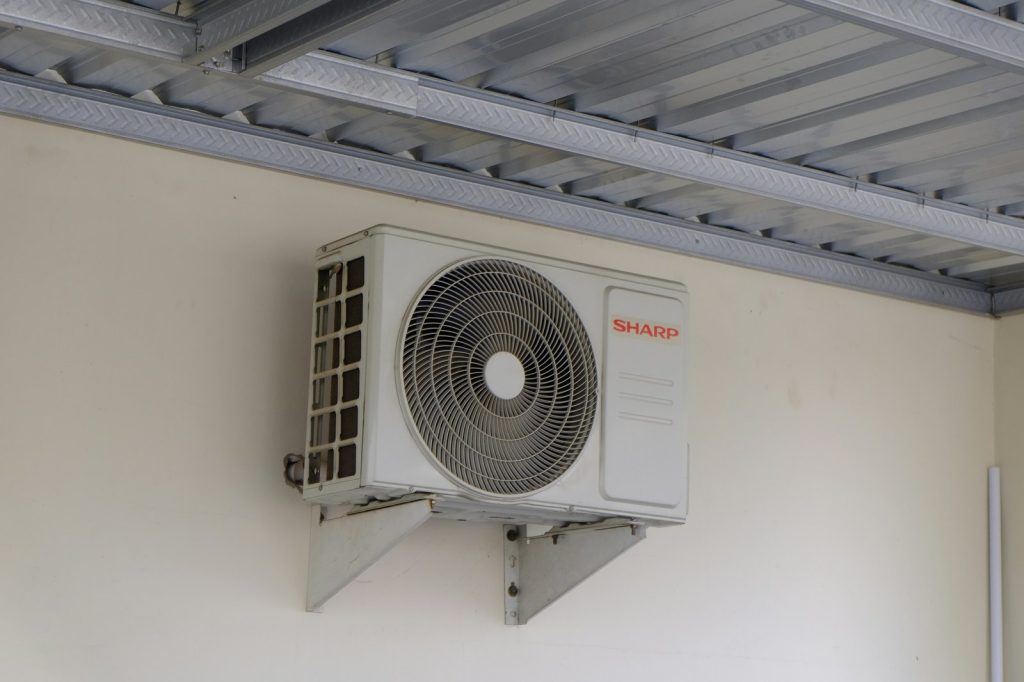
People expect a neat chart for this, something like “a 1.5 ton unit needs X wire and Y breaker.” The honest answer is shorter and more reliable: it is printed on the air conditioner itself. Sizing an AC circuit off a generic chart is how units get under-wired, and that is a fire risk, not a shortcut.
The nameplate is the answer
Every air conditioner and heat pump carries a data plate, usually on the outdoor unit, with two numbers that do the job for you.
The first is the MCA, or Minimum Circuit Ampacity. That tells you how much current the circuit has to be able to carry, and it sets the minimum wire size. If the MCA is 14 amps, you need wire rated for at least that, and if it nudges above what one gauge can carry, you step up to the next. So MCA sizes the wire, full stop.
The second is the MOP, sometimes written MOCP, the Maximum Overcurrent Protection. That is the largest breaker or fuse you are allowed to put on the circuit. Your breaker has to be at or below that number. If the MOP is 30 amps, a 30 or 25 amp breaker is fine, but a 40 is not.
Read those two numbers and the sizing is decided by the manufacturer, not guesswork.
The rule that makes AC different
Here is the part that confuses people, and even trips up some handymen. On a normal circuit, the breaker must protect the wire, so a 20 amp breaker goes on wire rated for 20 amps. With air conditioners, that rule changes.
Under the electrical code for AC and heat pump circuits, the breaker is allowed to be larger than the wire’s usual rating. That sounds wrong, but it is deliberate. The unit has its own internal overload protection, and the breaker is there mainly to let the compressor draw its big startup surge for a second without tripping. So you can correctly end up with, say, a 30 amp breaker on wire that would normally pair with a 20. It looks like a mistake on paper. On an AC circuit, following the nameplate, it is correct. This is also why you should never copy AC sizing onto a regular outlet or lighting circuit.
A few practical points
An air conditioner of any real size wants its own dedicated circuit, not one shared with outlets or lights. A small window unit pulling only a few amps can usually live on an ordinary circuit as long as nothing heavy shares it, but a mini-split or a central system needs its own run back to the panel.
As a very rough sense of scale, a small window unit often sits on a 15 amp circuit, a mini-split commonly lands around 15 to 20 amps, and a central system can want anywhere from 20 to 40 amps or more depending on its size. Treat those as orientation only. The nameplate overrules every one of them.
On a long cable run, the wire often needs to be a size bigger than the bare minimum to deal with voltage drop, because a motor fed on sagging voltage runs hot and dies early, which is the same problem we describe in surge protection for appliances in outage-prone areas.
Do not just fit a bigger breaker
If an air conditioner keeps tripping its breaker, the answer is not to fit a bigger one. Going past the MOP on the nameplate removes the protection the manufacturer designed in, and a breaker that trips is usually telling you about a real fault or an overloaded circuit. We go through why in why does my breaker keep tripping? The fix is to find the cause, not to silence the warning.
This is genuinely electrician work. The dedicated run, the correct wire gauge for the distance, the right breaker and the connections all have to be done properly and to code, and in Jamaica that work should be inspected. We handle AC circuits as part of wiring and installations. For the wire side of things, the American wire gauge system is the standard these sizes are quoted in.
Related reading
- Why does my breaker keep tripping? for why a tripping AC breaker is a clue, not a nuisance.
- Surge protection for appliances in outage-prone areas for protecting that expensive compressor.
- Wiring and installations for adding a dedicated, code-correct AC circuit.
How do I know what size wire and breaker my air conditioner needs?
Read the data plate on the unit, usually on the outdoor section. The MCA (Minimum Circuit Ampacity) tells you the minimum wire size, and the MOP or MOCP (Maximum Overcurrent Protection) tells you the largest breaker or fuse allowed. Size the wire to at least the MCA and the breaker at or below the MOP. The nameplate, not a generic chart, decides it.
Why can an air conditioner breaker be bigger than the wire rating?
The electrical code allows it for AC and heat pump circuits. The unit has its own internal overload protection, and the breaker is mainly there to let the compressor draw its large startup surge without tripping. So a breaker larger than the wire’s usual pairing can be correct here, even though it would be wrong on a normal outlet or lighting circuit.
Does an air conditioner need its own circuit?
Any air conditioner of real size does. A mini-split or central system needs its own dedicated circuit back to the panel. A small window unit drawing only a few amps can often share an ordinary circuit, as long as nothing heavy is on it with them, but a dedicated circuit is always safer.
What breaker size does a window air conditioner need?
Many small window units draw only about 4 to 8 amps and sit comfortably on a standard 15 amp circuit. Larger window units draw more and may need their own circuit. As always, check the unit’s label, since the manufacturer’s rating is what counts.
My AC keeps tripping the breaker. Should I fit a bigger one?
No. Fitting a breaker larger than the unit’s MOP removes the protection it was designed with and can be dangerous. A tripping breaker usually points to a real fault or an overloaded circuit, so the right move is to find the cause with an electrician rather than silence the warning.
Does a long cable run change the wire size for an AC?
It can. Over a long distance, wire often needs to be one size larger than the minimum to limit voltage drop. Running a motor on sagging voltage makes it overheat and shortens its life, so the distance from the panel to the unit is part of sizing the circuit correctly.
The next step
If you are installing a new air conditioner or your current one keeps tripping, the circuit behind it is worth getting right. Get a free quote or message us, and we will size and run a proper dedicated circuit to the unit’s nameplate, to code, and have it inspected.