

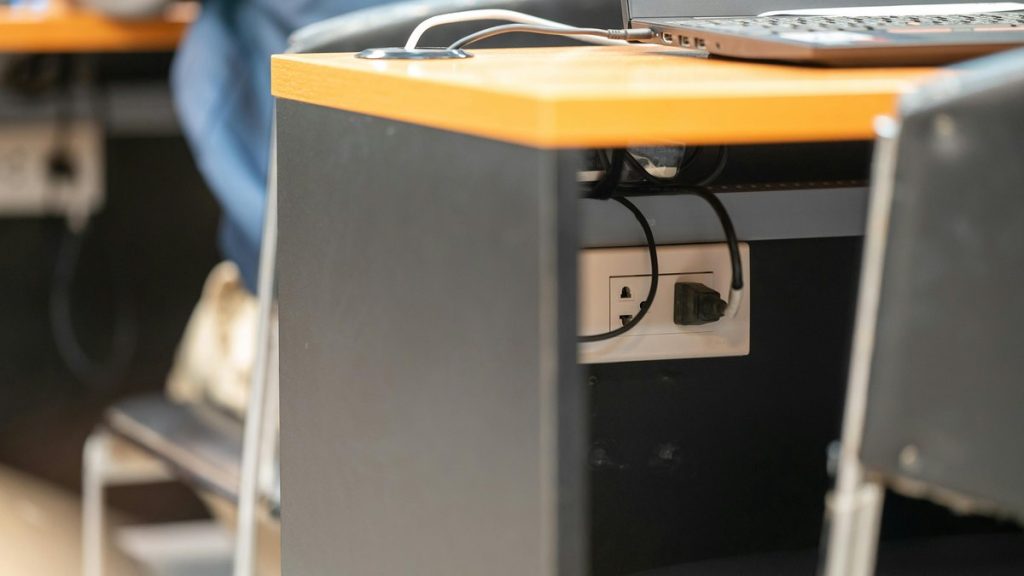
Look behind your TV, under the desk, or beside the bed, and there is a good chance you will find a power strip with more plugged into it than you remember adding. It is the most ordinary thing in the house, and that is exactly why it is easy to miss as a hazard. An overloaded extension board does not announce itself. It sits there working fine, day after day, while heat builds up inside it where nobody can see. Here is how that happens, what you can safely check, and the point where the answer is not a bigger strip but more outlets.
What “overloaded” actually means
Every extension board and every cord has a limit to how much current it can carry. A typical household power strip here is built for about 15 amps at 120 volts, which works out to roughly 1,800 watts in total across everything plugged into it. That number is not a suggestion. Run more than that through the strip, or through a thin cord, and the wire inside heats up. Push it hard enough or long enough, and that heat is what melts insulation, browns the plastic, and starts a fire.
And here is the part people miss: the breaker in your panel will not always save you. That breaker is sized to protect the wall circuit, not the skinny cord you plugged into it. A cheap extension cord or a tired old strip can overheat long before the breaker ever notices, because the breaker is watching the house wiring, not the weakest link you added to the end of it. It is the same overload story we tell in signs of overloaded circuits in your home, just squeezed into one little board.
Why the risk is hidden
The danger with extension boards is that the warning signs happen where you do not look. The strip lives behind furniture, under a rug, or in the back of a cabinet. The heat builds at the plug, inside the cord, or at the strip’s own outlets, slowly, over weeks. By the time you notice a faint smell of hot plastic, a warm spot, or a brown stain near a socket, the thing has been cooking for a while.
A few habits make it worse. Coiling the excess cord into a tight bundle traps heat instead of letting it escape. Running a strip under a carpet does the same and hides any scorching. Tucking it behind a couch means the day it starts to smoke, there is fabric right next to it. None of this looks dangerous, which is the whole problem.

Daisy-chaining is the worst version
The single riskiest thing people do with extension boards is plug one into another. A strip into a strip, or a strip into an extension cord, then more strips off that. It is called daisy-chaining, and it is banned under US electrical code and workplace safety rules for good reason. You end up running far more devices through one wall outlet than it or the first strip was ever meant to feed, and every extra connection and length of cord adds resistance, which means more heat. The strip plugged straight into the wall ends up carrying the load of everything downstream of it. You can read the basics on the Wikipedia power strip page.
If you are reaching for a second strip because the first one is full, that is the moment to stop and rethink, not to chain them together.
The appliances that should never go on a strip
Some things pull too much current to belong on an extension board at all. Anything that makes heat or runs a motor is the worst offender: a space heater, an iron, an electric kettle, a microwave, a window air conditioner, a fridge, a washing machine. One of these alone can eat most of a strip’s whole budget. Put two on the same board and you are over the limit before anything else goes in. These belong in a wall outlet, ideally on their own circuit.
Why this bites harder in Jamaican homes
A lot of homes here, especially older ones, were wired with very few outlets per room, sometimes one or two. So the extension board is not a luxury, it is how people make a room usable, and that is fair enough. The trouble is that scarcity quietly pushes everyone toward overloading: one strip ends up feeding the TV, the decoder, the fan, the phone chargers, and a console, all from a single wall socket that was never meant to run a room. Add our frequent outages, where everything switches back on at once when power returns, and a tired, overloaded strip is exactly the kind of weak point that fails at the worst moment.
What is safe to check, and what to do
You can do a quick safety round yourself. Go strip by strip and count what is actually plugged in. Anything that heats or has a motor, move it to a wall outlet. Gently feel whether a strip, cord, or plug is warm in normal use, since warmth means it is working too hard. Look for browning, melting, or scorch marks at any socket, and smell for hot plastic. Make sure no strip is buried under a rug, coiled tight, or pinned behind heavy furniture. And if you find a strip plugged into another strip, unplug the chain.
What you should not do is treat more strips as the cure. If you genuinely do not have enough outlets, the safe fix is to add proper wall outlets and, where needed, more circuits, so the load is spread across the house wiring the way it was designed to be. That is wiring installation work, and it is the difference between a room full of dangerous workarounds and one that simply has enough places to plug in.
When to call an electrician
Call someone if a strip, cord, plug, or outlet is warm, scorched, or smells hot, if a breaker keeps tripping when you use a particular board, or if you are leaning on extension boards because there are not enough outlets to go around. The first two are signs something is already overheating. The last one is the root cause, and it is the one worth fixing properly. A tripping breaker in particular is a warning, not a nuisance, which is why we say never keep resetting a tripping breaker.
The takeaway
An extension board is a convenience with a hard limit, and the danger is that it hides its own distress. It overheats out of sight, behind furniture and under rugs, long before you smell or see anything. Keep heavy, heat-making appliances on wall outlets, never plug one strip into another, do not bury or coil the cords, and treat any warmth or scorching as a stop sign. Most of all, if you are using strips because the room ran out of outlets, the honest fix is more outlets, not more strips. That is the change that takes the hidden risk away for good.
Related reading
- Why extension cords cause fires for the cord side of the same problem.
- Signs of overloaded circuits in your home for the warning signs at the circuit and panel.
- Signs your wiring is a fire risk for the broader red flags worth knowing.
- Wiring installations to add proper outlets and circuits so you can retire the strips.
How do I know if my power strip is overloaded?
Add up what is plugged in. A typical strip is rated for about 15 amps at 120 volts, roughly 1,800 watts total. Signs of overload include the strip, cord, or plug feeling warm in normal use, browning or scorch marks at a socket, a smell of hot plastic, or a breaker that trips when you use that strip. Any of these means it is carrying too much.
Why is daisy-chaining power strips dangerous?
Plugging one strip into another, or into an extension cord, runs far more devices through a single wall outlet than it was meant to feed, and every extra cord and connection adds resistance and heat. The strip plugged into the wall carries the whole load downstream of it. It is banned under US electrical code and workplace safety rules for that reason.
What should never be plugged into an extension board?
Anything that makes heat or runs a motor: space heaters, irons, electric kettles, microwaves, window air conditioners, fridges and freezers, and washing machines. These draw heavy current and can use most or all of a strip’s capacity on their own. They should plug directly into a wall outlet.
Will the breaker protect me from an overloaded extension cord?
Not reliably. The breaker is sized to protect the house wiring on that circuit, not the thin cord or strip you plug into it. A cheap or worn cord can overheat well before the breaker reacts, because the breaker is watching the wall circuit, not the weakest link you added.
Why does the strip get hot even when nothing seems wrong?
Heat builds where you do not look: at the plug, inside the cord, or at the strip’s sockets, slowly over weeks. Coiling the spare cord tightly, running the strip under a rug, or pinning it behind furniture traps that heat. By the time you notice warmth or a smell, it has been overheating for a while.
What is the real fix if I do not have enough outlets?
More outlets, not more strips. If a room makes you rely on extension boards, the safe answer is to add proper wall outlets and, where needed, extra circuits, so the load is spread across the house wiring as designed. An electrician can add outlets where you actually need them.
The next step
Relying on extension boards because a room ran out of outlets? Get a free quote or message us, and we will add proper outlets and circuits where you need them, so you can retire the daisy-chained strips for good.