

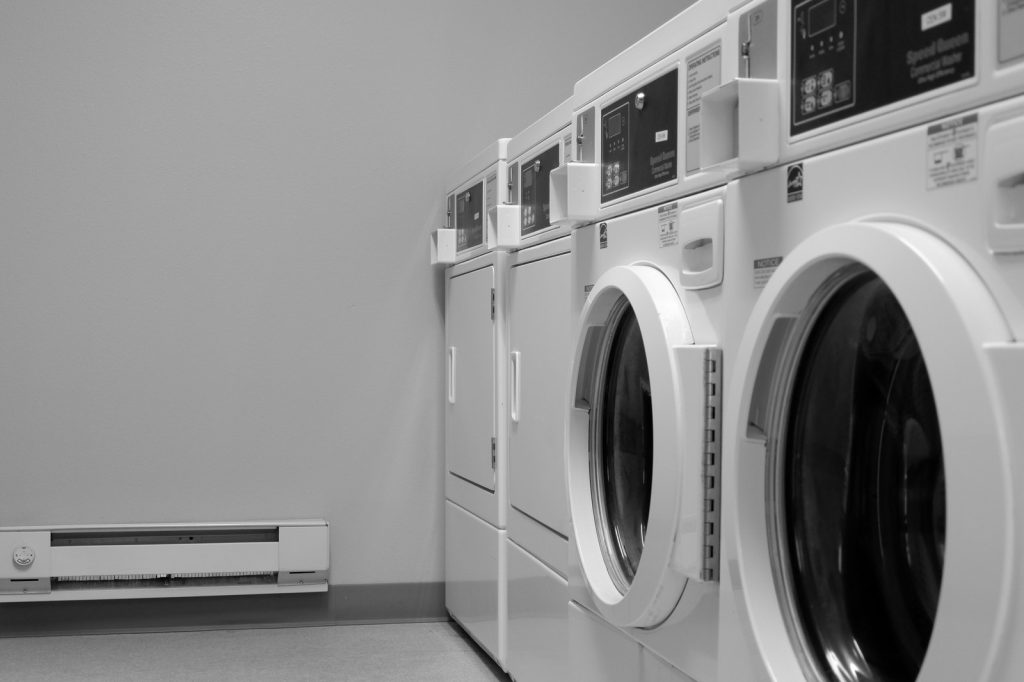
After a run of hungry 240-volt appliances, the washing machine is a relief. It plugs into an ordinary outlet, sips only a little power, and asks for nothing exotic. But “modest” does not mean “anything goes,” and there are still two rules worth getting right, one of which is a genuine safety matter because of where a washer lives.
The circuit
A washing machine runs on ordinary 120 volts and draws only a little, somewhere around 5 to 15 amps depending on the model and what part of the cycle it is in. It plugs into a standard grounded three-prong outlet, the familiar NEMA 5-15 or 5-20.
Even so, the laundry area is supposed to have its own dedicated 20-amp circuit, wired with 12-gauge copper. That is not because the washer is power-hungry; it is so the laundry has a reliable supply of its own rather than fighting other rooms for power. Pair a 20-amp breaker with 12-gauge wire, never thinner, because 14-gauge on a 20-amp breaker can overheat and is a fire risk.
The rule that matters: GFCI
Here is the safety one. A washing machine sits right next to plumbing and water, so its outlet must have ground-fault circuit-interrupter protection, a GFCI. This is required for laundry receptacles, and it is the rule we would never let slide, because the whole point of a GFCI is to cut the power instantly if current starts leaking where water is around.
One practical detail: the GFCI has to stay reachable. You cannot bury it behind a heavy washing machine where nobody can reach the reset button, so it is usually set up as a GFCI breaker at the panel or an accessible outlet nearby. Read more about how these devices work under residual-current device.
What it can and cannot share
The 20-amp laundry circuit can serve a gas dryer alongside the washer, since a gas dryer only needs a little electricity for its motor and igniter. What it must not share with is a 240-volt electric dryer, which needs its own dedicated circuit, as we cover in what size wire and breaker does a clothes dryer need? And please do not run the washer off a random extension cord from the next room; the dedicated laundry circuit exists for a reason.
Leave the circuit and GFCI to an electrician
Plugging the washer in is your job. Running the dedicated circuit, fitting the right outlet and setting up the GFCI properly, in a wet area, is electrician work, and it should be done to code and inspected. We handle laundry and other circuits as part of wiring and installations.
Related reading
- What size wire and breaker does a clothes dryer need? for the washer’s heavier laundry-room partner.
- What size wire and breaker does a pool pump need? for another circuit where GFCI protection near water is the key rule.
- Wiring and installations for a dedicated, GFCI-protected laundry circuit done to code.
What size breaker and wire does a washing machine need?
A washing machine runs on a standard 120-volt circuit and the laundry area should have its own dedicated 20-amp branch circuit, wired with 12-gauge copper, ending at a normal grounded outlet (NEMA 5-15 or 5-20). The washer itself only draws around 5 to 15 amps, but the dedicated 20-amp circuit is what the code calls for.
Does a washing machine outlet need GFCI protection?
Yes. A washing machine sits next to plumbing, so its receptacle must have ground-fault circuit-interrupter (GFCI) protection. This is required for laundry receptacles regardless of whether there is a sink. The GFCI also has to stay reachable, so it is usually a GFCI breaker or an accessible outlet rather than one hidden behind the machine.
Can a washing machine share a circuit?
The 20-amp laundry circuit can serve a gas dryer alongside the washer, since a gas dryer uses little electricity. It must not share with a 240-volt electric dryer, which needs its own dedicated circuit. And it should never be run off a casual extension cord from another room.
Why does the laundry need a dedicated circuit if the washer uses little power?
The dedicated circuit is not about the washer being power-hungry; it is so the laundry area has a reliable supply of its own rather than competing with other rooms. The electrical code requires a dedicated 20-amp circuit for the laundry receptacle for this reason.
Can I use 14-gauge wire for a washing machine circuit?
No. A 20-amp laundry circuit must use 12-gauge copper wire. Thinner 14-gauge wire on a 20-amp breaker can overheat and is a fire risk, because the breaker allows more current than the thin wire can safely carry.
Do I need an electrician for a washing machine circuit?
Plugging in the washer is simple, but running the dedicated circuit, fitting the correct outlet and setting up GFCI protection in a wet area is electrician work that should be done to code and inspected. The circuit, not the plug, is the part to leave to a professional.
The next step
Setting up a laundry area, or not sure your washer outlet is properly protected? It is worth a check. Get a free quote or message us, and we will run a dedicated, GFCI-protected laundry circuit to code, so the one appliance that lives in water is safely wired.