

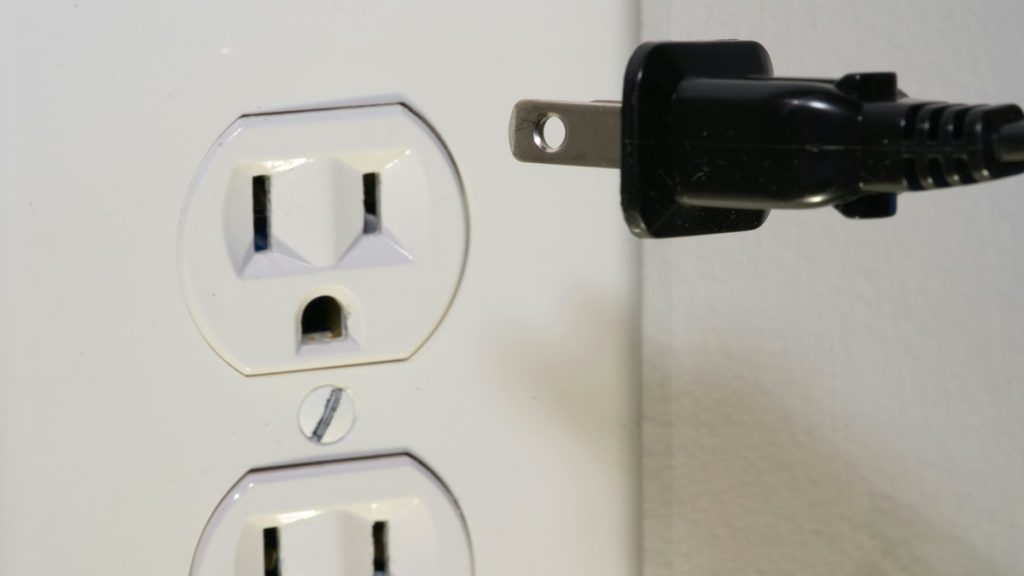
Look at the outlets in an older home and you will often find the two-hole kind, with no third hole below. Newer outlets have that third, rounded hole, and the difference is not cosmetic. The third hole is the ground, a safety feature that can stop a fault from becoming a shock. Here is what grounding actually does, why an ungrounded outlet is worth taking seriously, and the safe and unsafe ways to deal with it.
What the third prong is for
A two-prong outlet has two wires behind it: a hot wire that carries the current and a neutral that returns it. That is enough to run an appliance. A three-prong outlet adds a third wire, the ground, and in normal use the ground carries no current at all. It just sits there, waiting, connected to the metal parts of your appliances and running back to earth at your panel. The Wikipedia ground page) covers the principle.
Its job only shows up when something goes wrong. Say a hot wire inside an appliance works loose and touches the metal casing. That casing goes live, and the next person to touch it becomes the path for the current, taking a shock that can be fatal. The ground gives that fault current an easier path to follow, straight back to the panel, where it draws enough current to trip the breaker and cut the power. So the ground turns a deadly situation into a tripped breaker.
Why ungrounded outlets are a real risk
A two-prong, ungrounded outlet simply leaves that protection out. If an appliance faults, there is no safe path for the stray current, so the casing can sit there live and waiting. That is the main danger, and it is reason enough to take ungrounded outlets seriously, especially for anything with a metal body.
There is a second cost that catches people out. Surge protectors need a ground to do their job. They work by shunting a voltage spike into the ground wire, so on an ungrounded outlet the surge protector has nowhere to send the surge, and your electronics are far less protected than the power strip’s little lights suggest. With our power swings and storms, that matters more than it does most places.
The unsafe shortcut to avoid
Here is the trap. Because three-prong plugs do not fit two-prong outlets, it is tempting to just swap in a three-prong outlet, or use a little three-to-two adapter, or worst of all snap the ground pin off the plug. All three are dangerous in the same way: they let the plug connect, but there is still no actual ground behind it. You end up with an outlet that looks modern and safe and protects no one, which is worse than the honest two-prong outlet it replaced, because now you trust it.
Fitting a three-prong receptacle where no ground wire exists is one of the most common dangerous shortcuts in a home, and you cannot tell from the front that someone has done it. A cheap plug-in outlet tester, or an electrician, can show whether a three-prong outlet is genuinely grounded.
The safe ways to fix it
Two proper routes, both electrician work. The best is to run an actual ground wire to the outlet so it is truly grounded, which usually means running a conductor back toward the panel. Done right, that gives you a real three-prong outlet with all the protection the third prong promises.
Where running a new ground wire is genuinely impractical, the recognised alternative is to protect the outlet with a GFCI, which is allowed to replace an ungrounded outlet as long as it is labelled to show there is no equipment ground. The GFCI watches for current leaking to ground and cuts power in a fraction of a second, so it protects people from shock even without a ground wire. What it does not do is provide a ground path, so surge protectors still will not work fully on it. Which route makes sense comes down to your wiring, and that is a judgement for an electrician. Either way, it falls under wiring installation and is not a do-it-yourself job.
The takeaway
The third prong is the ground. It exists to carry a fault safely away instead of through you, and it is also what lets surge protectors actually protect your electronics. A two-prong, ungrounded outlet leaves that out, a genuine risk for metal-bodied appliances and sensitive equipment alike. Never fake it by fitting a three-prong outlet with no ground behind it, using a cheater adapter, or cutting off a ground pin, because all of those hide the danger instead of fixing it. The real fixes, a proper ground wire or a correctly labelled GFCI, are straightforward for an electrician and worth doing.
Related reading
- GFCI outlets: what they are and where you need them for the device that can protect an ungrounded outlet.
- Signs of a loose electrical connection for another hidden wiring risk.
- What causes a dead outlet? for more on what is happening behind your outlets.
- Wiring installations to add a proper ground or fit a labelled GFCI.
What is the difference between a two-prong and three-prong outlet?
A two-prong outlet has only a hot and a neutral wire, which is enough to power an appliance. A three-prong outlet adds a ground wire, a safety path that carries fault current away if something goes wrong. The ground does not carry current in normal use; it only acts when there is a fault.
What does the third prong actually do?
It connects the metal parts of an appliance to ground. If a hot wire comes loose and touches the casing, the ground gives that current an easy path back to the panel, which trips the breaker and cuts power, instead of the casing going live and shocking whoever touches it. It turns a deadly fault into a tripped breaker.
Are two-prong outlets dangerous?
They carry more risk than grounded outlets because a faulty appliance has no safe path for stray current, so its metal casing can become live. Ungrounded outlets also stop surge protectors from working, since a surge protector needs a ground to divert spikes. For metal-bodied appliances and electronics, that is a real concern.
Can I just put a three-prong outlet on ungrounded wiring?
No, and it is dangerous. Fitting a three-prong outlet, using a three-to-two adapter, or cutting off a ground pin all let a plug connect without any real ground behind it. The result looks safe but protects no one, which is worse, because you start trusting an outlet that has no ground. It must be done properly.
How do I know if a three-prong outlet is really grounded?
You cannot tell from the front, since an ungrounded three-prong outlet looks identical to a grounded one. A simple plug-in outlet tester, or an electrician, can confirm whether the ground is actually connected. This is worth checking in older homes where three-prong outlets may have been fitted without a ground.
What is the safe way to upgrade a two-prong outlet?
Two proper routes, both electrician work. The best is to run a real ground wire to the outlet so it is genuinely grounded. Where that is impractical, a GFCI can replace the ungrounded outlet if it is labelled to show there is no equipment ground; it protects against shock but does not restore surge protection.
The next step
If your home has two-prong outlets, or three-prong outlets you are not sure are grounded, it is worth knowing where you stand. Get a free quote or message us, and we will test your outlets and ground them properly so the protection you think you have is really there.