

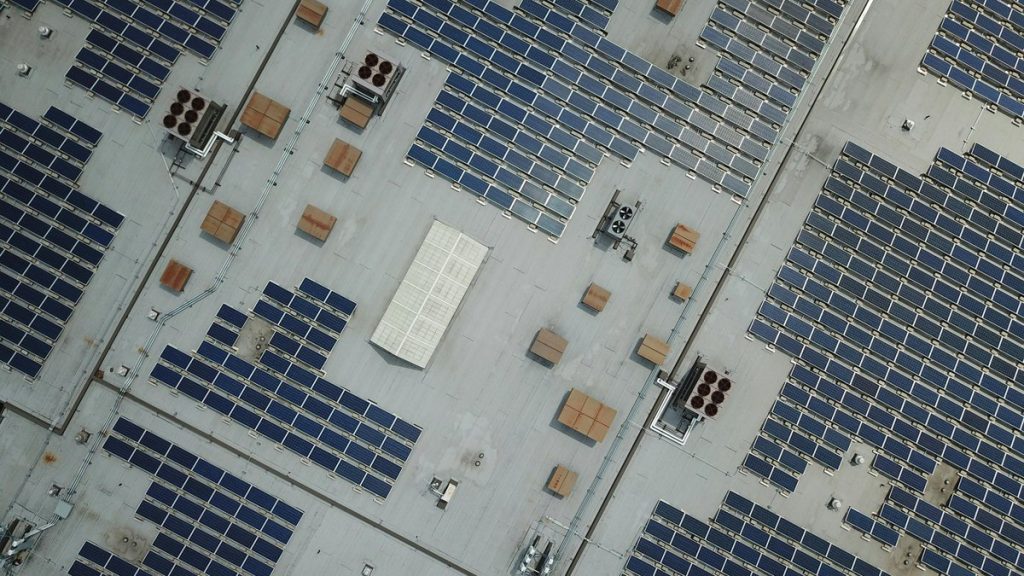
The flat concrete slab, common on newer and urban Jamaican homes, is one of the best roofs to put solar on, for one reason: you are not stuck with whatever slope the builder gave you. You can aim the panels at the sun. The two questions that decide how the job is done are how the array is held down, and how the roof stays watertight. Here is what to know.
The flat-roof advantage
On a pitched roof, the panels lie at whatever angle the roof gives them, and that is that. On a flat slab, they go on tilt frames aimed at the sun, with the rows spaced so they do not shade one another. So a flat roof can be set up for the best output instead of settling for the builder’s pitch. The trade is that it takes a bit more planning and a bit more room. You can read about mounting systems under photovoltaic mounting system.
Two ways to hold it down
There are two ways to fix an array to a concrete roof, and they pull in opposite directions.
A ballasted mount uses weight, not holes. The frames sit in trays held down by heavy blocks, so nothing pierces the roof. Since most roof leaks start at a penetration, no penetrations means no leaks from the mounting, and it is kind to the roof’s waterproofing. The catch is wind: the array has to be weighted enough to stay put, and the slab has to be able to carry that weight.
An anchored, or penetrating, mount bolts the frame into the slab, with each fixing flashed and sealed. It gives the strongest hold, adds very little weight, and is the better choice where the wind is fierce. The price of that strength is that every penetration has to be waterproofed meticulously, or it leaks.
Which one suits Jamaica
Here the wind makes the call. A light ballast that would sit happily on a calm-climate roof can shift or lift in a hurricane, and an array that moves in a storm is dangerous. So in our conditions we lean toward proper anchoring, or a heavily engineered ballast designed for real wind loads, rather than the minimum weight that just looks stable on a still day. The aim is simple: an array that does not budge when the next big storm comes through.
Waterproofing is the other half of the job
A concrete roof is usually sealed with a membrane or a waterproof coating, and that protection has to be respected, not punched through and forgotten. Every anchored fixing is flashed and resealed so water cannot track in. Trays and frames are placed so they do not dam up water or sit in a puddle, because flat roofs already fight ponding. And before any array goes up, the existing waterproofing is checked and repaired where needed, since it is far easier to fix it with a clear roof than with panels in the way.
Heat, airflow and earthing
Two smaller points round it out. Tilt frames lift the panels off the hot slab, so air moves underneath and the panels run a little cooler and produce better. And as with any metal mounting, the frames are bonded and earthed so the whole array is electrically safe.
Doing it to standard
A concrete-roof system, like any solar install, must be mounted, wired and protected to standard and pass a Government Electrical Inspectorate inspection before the supply is connected. On a flat roof the mounting and the waterproofing are as much part of doing it right as the wiring.
What we do here
We install solar on concrete roofs with the mounting matched to our wind, ballasted where it genuinely holds or anchored and flashed where it is the safer bet, and always with the roof’s waterproofing protected and checked first. The first step is a look at the roof and a real quote.
Related reading
- Solar on a zinc roof: what to know for the other common Jamaican roof type.
- Protecting your electrics through hurricane season for keeping a roof array storm-ready.
- How much roof space does solar need? for laying an array out on a flat roof.
- Solar installation for solar mounted and sealed properly on concrete.
Can you put solar on a flat concrete roof?
Yes, and it is one of the most flexible roofs for solar. Panels sit on tilt frames angled toward the sun, with rows spaced so they do not shade each other, so you can set the array up for the best output rather than being stuck with a fixed slope. The main decisions are how it is anchored and how the roof’s waterproofing is protected.
What is the difference between ballasted and anchored mounting?
A ballasted mount holds the array down with weight, with frames sitting in trays loaded with blocks and nothing piercing the roof, so there are no penetrations to leak. An anchored mount bolts the frame into the slab with each fixing flashed and sealed, giving the strongest hold with little added weight but requiring meticulous waterproofing at every point.
Which mounting is better for hurricanes?
In our wind, proper anchoring or a heavily engineered ballast is the safer bet. A light ballast that looks stable on a calm day can shift or lift in a hurricane, and an array that moves in a storm is dangerous. The goal is an array sized and fixed to stay put under real wind loads, not the bare minimum.
Will mounting solar cause my concrete roof to leak?
Not if it is done properly. A ballasted system adds no penetrations at all. An anchored system flashes and seals every fixing so water cannot track in. The bigger risk is poor workmanship, which is why the existing waterproofing is checked and repaired first and every penetration is sealed correctly.
Does the existing roof waterproofing matter?
Very much. A concrete roof is usually sealed with a membrane or coating that has to be respected. Fixings are flashed and resealed, trays and frames are placed so they do not trap water or cause ponding, and any worn waterproofing is repaired before the array goes up, since that is far easier with a clear roof.
Does a flat roof need tilt frames?
Yes, that is the advantage of a flat roof. Panels go on frames angled toward the sun rather than lying flat, which improves output and lets rain run off and clean them. The rows are spaced so one does not shade the next, which uses a little more room than a pitched roof but lets the array be optimised.
The next step
A concrete roof gives you the freedom to aim the panels; the craft is in holding the array down for a storm and keeping the roof dry. Get a free quote or message us, and we will assess the roof, its waterproofing and the right mounting for our wind.