

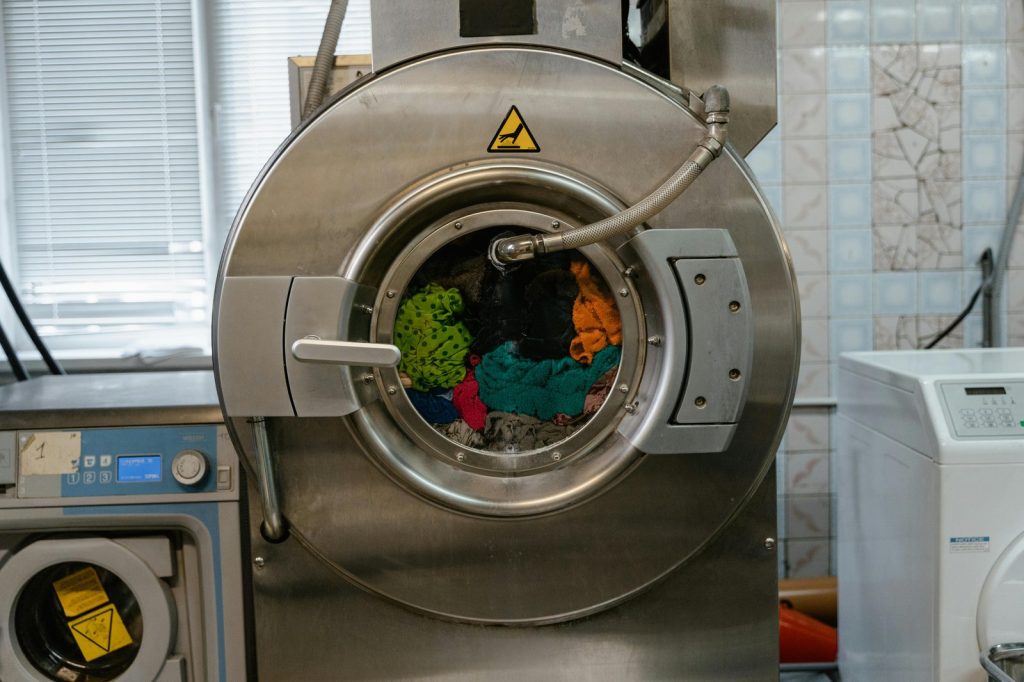
A washing machine is the wettest appliance in your house that also has a motor inside it, and that combination is exactly why it trips the breaker. Two suspects do most of the damage: water finding its way into the electrics, and the motor straining during the spin. The good news is that when it trips usually tells you which one you are looking at.
When it trips is the biggest clue
If the breaker goes during the spin cycle, look at the motor. Spin is the hardest the machine works, ramping the drum up to full speed, and that surge of current is where a worn motor or a failing capacitor, the part that gives the motor its starting push, draws more than the breaker allows. Worn motor bearings do the same thing, making the motor pull too much as it fights to turn. A spin-cycle trip is the classic washer fault.
If it trips during the drain or fill, suspect the drain pump. A failing or leaking pump can short or over-draw when it kicks in, so a trip that lands at the same point in every wash points there.
If it trips the instant you start it, before anything moves, that is more like a dead short in the motor windings or the wiring. And if it trips at random, after running fine for a while, that smells of moisture or a loose connection heating up.
The water angle, which is the washer’s own problem
This is the part that makes a washer different from, say, a fan. Water leaks, from a split hose, the pump, or on a front-loader the heating element, can reach the electrical parts inside. When water bridges across to the machine’s metal frame, current leaks to ground, and that is both a trip and a genuine shock risk if you touch a wet machine. That is why laundry outlets are usually fitted with a GFCI, which watches for exactly that leakage and cuts the power fast.
Do not bypass the GFCI
A washer that keeps tripping a GFCI is often catching real current leaking to the frame, not being fussy. So do not swap that GFCI for an ordinary breaker to stop the nuisance. On a machine full of water that you stand in front of with wet hands, that protection is the thing between a leak and a shock. Reset it once, and if it trips straight back, leave it and get it checked, the same rule we give in why does my breaker keep tripping?
The checks that are yours
Two things are safe to check yourself. First, is the washer sharing a circuit? Unplug anything else on that line and run a wash on its own; if it stops tripping, the circuit was overloaded. Second, is there water under or behind the machine? If you can see a leak, stop running it, because that is very likely your fault and running a leaking washer is asking for a shock. Beyond those two, you are into the machine itself, and a wet appliance is not the place for guesswork.
Who fixes it
A tripping washer splits between two trades. The motor, the bearings, the capacitor, the drain pump and any internal leak are appliance-repair work. The circuit, the outlet, the GFCI, the breaker and any leakage to ground are ours, and that electrical side is what we test first so you are not paying to open the machine for a fault that was in the wall. We do that as part of power outage and fault finding.
Related reading
- What size wire and breaker does a washing machine need? for the circuit and GFCI a washer should be on.
- Why does my breaker keep tripping? for the wider picture on tripping breakers.
- Power outage and fault finding for tracing whether it is the circuit or the machine.
Why does my washing machine trip the breaker during the spin cycle?
Spin is the hardest the machine works, ramping the drum to full speed, and that surge of current is where a worn motor, worn bearings or a failing capacitor draws more than the breaker allows. A trip that lands during spin is the classic washer fault, and it usually means the motor or its capacitor needs an appliance technician.
My washer trips the breaker when it drains. What does that mean?
A trip that happens at the drain or fill stage usually points to the drain pump. A failing or leaking pump can short or over-draw when it runs, so if the breaker goes at the same point in every wash, the pump is the likely suspect. That is appliance-repair work, not a circuit fault.
Can water make my washing machine trip the breaker?
Yes, and it is the washer’s own particular problem. A leak from a hose, the pump, or a front-loader’s heating element can reach the electrics, and when water bridges to the metal frame, current leaks to ground. That trips the breaker and is a shock risk if you touch a wet machine, which is why laundry outlets usually have a GFCI.
Can I bypass the GFCI to stop my washer tripping?
No. A washer that keeps tripping a GFCI is often catching real current leaking to the frame, not being fussy. Swapping it for an ordinary breaker removes the protection that stands between a leak and a shock on a machine full of water. Reset once, and if it trips again, get it checked rather than defeating the GFCI.
What can I safely check myself?
Two things. Check whether the washer shares a circuit by unplugging everything else on that line and running a wash alone; if it stops tripping, the circuit was overloaded. And check for water under or behind the machine; if you see a leak, stop running it, because a leaking washer is a shock risk. Beyond those, leave it to a professional.
Do I need an electrician or an appliance technician?
It depends on the cause. The motor, bearings, capacitor, drain pump and internal leaks are appliance-repair work. The circuit, outlet, GFCI, breaker and any leakage to ground are electrical, so an electrician tests those first to tell you which way the fault lies before you pay to open the machine.
The next step
If your washing machine keeps tripping, note when it goes, check for a shared circuit and any visible water, and stop resetting it. Get a free quote or message us, and we will test the circuit, outlet, GFCI and breaker and tell you honestly whether it is electrical or one for an appliance technician.