

Most people start with the wrong question. They ask how many panels they need, when the number they actually need is sitting on their JPS bill. Sizing a solar system is mostly arithmetic, and you can get a solid first estimate yourself in about ten minutes. Here is how the maths works, with a worked example for a Jamaican home, and then the local things that nudge the answer one way or the other.
Start with your kWh, not your dollars
Your bill has two numbers that matter, and most people only look at one. The dollar total is the one that hurts, but the number that sizes a solar system is the kilowatt-hours, written as kWh, which is the actual amount of electricity you used that month. Find that figure.
Then do not trust a single month. Pull up the last 12 months if you can, because usage swings with the seasons. The months you run the air conditioner hard will be much higher than the cool months, and you want to size for your real pattern, not for one lucky low bill. Add the 12 months together and divide by 12 to get your average monthly kWh.
Turn months into days
Solar production happens day by day, so convert your monthly figure to a daily one. Divide your average monthly kWh by 30.
If your average is 600 kWh a month, that is 20 kWh a day. Hold onto that number, because it is the load your system has to cover.
Understand peak sun hours
Here is the part people get wrong. A solar panel does not make full power for every hour the sun is up. “Peak sun hours” is the way to measure the usable sunlight in a day, counting only the equivalent hours of strong, full-strength sun.
We get strong sun here, but not all of it counts. Between cloud, haze and the afternoon rain, a sensible working figure for peak sun hours in Jamaica is around four and a half to five hours a day, not the eight or nine hours of daylight you actually see out the window. Design around the realistic number, not the hopeful one.
Do the sizing maths
The core formula is simple. Your daily production equals the system size in kilowatts, times the peak sun hours, times a loss factor for the real world.
That loss factor matters a lot in Jamaica. Heat itself robs panels of output, and our roofs get hot, so panels here run below their lab rating on a bright day. Add normal losses in the wiring, the inverter and a bit of dust, and a realistic loss factor is about 0.8, meaning you actually get around 80 percent of the theoretical figure.
Rearranged to find the size you need: system size equals your daily kWh, divided by peak sun hours, divided by that 0.8 loss factor.

A worked example
Take our 20 kWh a day home, with 4.5 peak sun hours and a 0.8 loss factor.
20 divided by 4.5 is about 4.4. Divide that by 0.8 and you get about 5.5 kilowatts. So this home needs a system of roughly 5.5 kW to cover its full usage on an average day.
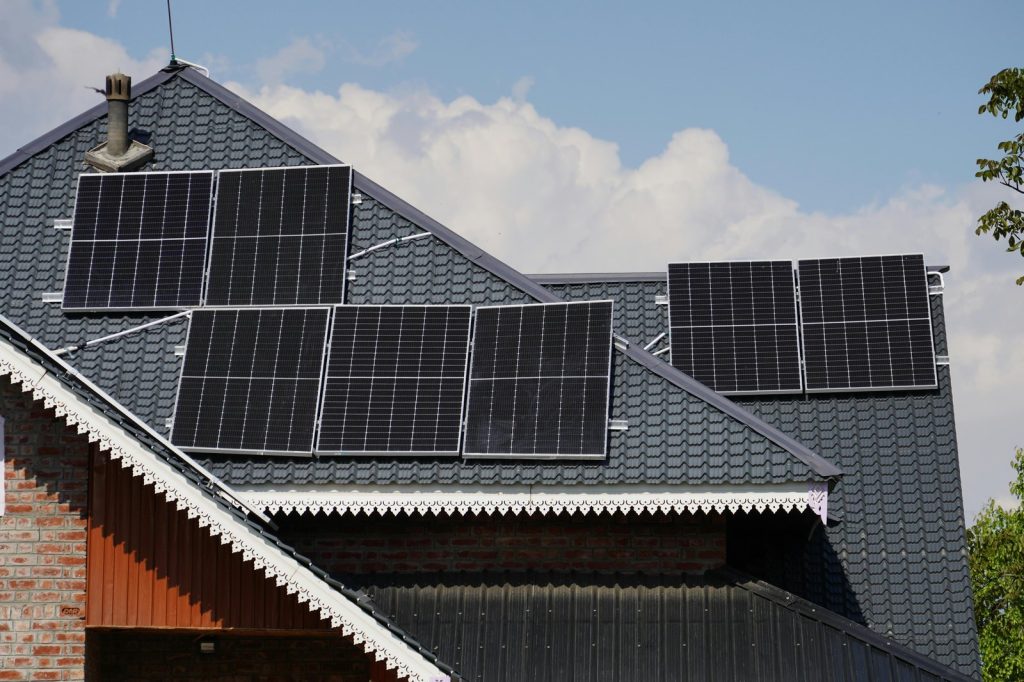
To turn that into a panel count, divide by the size of one panel. A common modern panel is around 400 watts, which is 0.4 kW. So 5.5 divided by 0.4 is about 14 panels.
That is your back-of-the-envelope answer: roughly a 5.5 kW system, about 14 panels, for a 600 kWh-a-month home. Your own numbers will differ, but the method is the same every time.
The net billing twist: do not just chase 100 percent
This is where the simple maths meets a Jamaican reality. Because JPS uses net billing, the power you use yourself is worth more than the power you export, since exports are credited at a lower rate. So sizing a system to wipe out 100 percent of your usage on paper is not automatically the best value.
What usually pays off better is sizing the system around the power you can actually use during daylight, when the panels are producing. If most of your consumption is in the evening, a giant array spends the day selling cheap power to the grid and you still buy expensive power at night. In that case a slightly smaller array, or one paired with a battery to shift daytime energy into the evening, often beats simply maximising panel count. We work through that trade-off in solar system planning.
The things a calculator cannot see
The maths gives you a target. A few real-world factors decide whether your roof can hit it:
- Roof space and orientation. You need somewhere to put 14 panels, ideally facing the right way and at a sensible tilt. A cramped or awkwardly shaped roof limits the array.
- Shading. A tree, a water tank or a neighbour’s wall throwing shade across the panels for part of the day cuts production more than people expect.
- Future loads. If a new air conditioner, an electric water heater or an EV is on the horizon, it is often smarter to size for that now than to retrofit later.
- Budget and phasing. You do not have to do it all at once. Some homes start smaller and expand, as long as the design allows for it.
Why the estimate is a starting point, not a quote
The ten-minute version is genuinely useful, and we would rather you walk in understanding it. But a proper design looks at your actual load profile, not just a monthly total, along with your roof, your shading and your plans. That is the difference between a number that sounds right and a system that performs the way you expect. Treat your own calculation as the sanity check you hold a quote up against.
Related reading
- How JPS net billing actually works for why self-use beats export and how that changes sizing.
- Is solar worth it in Jamaica right now? for the payback picture behind the system size.
- Solar system planning for how we turn your bill and roof into a proper design.
How do I figure out what size solar system I need?
Start with the kWh figure on your JPS bill, averaged over about 12 months. Divide the monthly average by 30 to get daily usage, divide that by Jamaica’s realistic peak sun hours (around four and a half to five), then divide by a loss factor of about 0.8 to allow for heat and system losses. That gives your system size in kilowatts.
How many solar panels does a typical Jamaican home need?
It depends entirely on usage, but as an example, a home using about 600 kWh a month works out to roughly a 5.5 kW system, which is about 14 modern 400-watt panels. A home with heavy air conditioning needs more; a light user needs fewer. Your own bill gives the real number.
What are peak sun hours in Jamaica?
Peak sun hours measure the equivalent hours of full-strength sun per day, not total daylight. In Jamaica, once you allow for cloud, haze and afternoon rain, a realistic working figure is around four and a half to five hours a day, even though you see far more daylight than that.
Why should I not just size solar to cover 100 percent of my bill?
Because JPS uses net billing, the power you use yourself is worth more than the power you export, which earns a lower rate. Sizing purely to erase your bill on paper can mean exporting a lot of cheap daytime power and still buying expensive power at night. Sizing around your daytime use, sometimes with a battery, often gives better value.
Does heat affect how big my solar system should be?
Yes. High temperatures reduce a panel’s output below its lab rating, and our roofs get hot, so panels in Jamaica produce less than the sticker figure on a bright day. A realistic loss factor of about 0.8 builds that in, which is why a system is sized a bit larger than the raw maths suggests.
Can I just use my last electricity bill to size a system?
One bill is a rough guide, but usage swings with the seasons, especially with air conditioning. Using about 12 months of bills captures your real pattern and avoids sizing for a single unusually low or high month. The average is what you design around.
The next step
The maths above gets you a solid estimate. Turning it into a system that performs takes a proper look at your load, your roof and your plans. Get a free quote or message us with your recent kWh, and we will size a system around how you actually use power, not just the total on the bill.